
Power Plant Industries
Wind and Gas Turbines
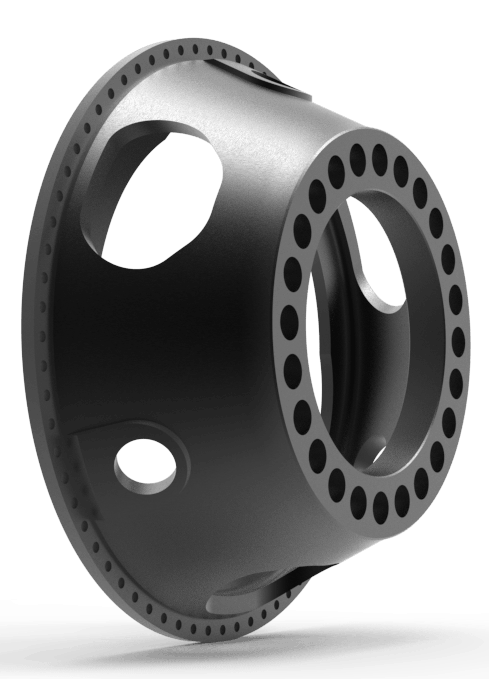
| Part Name | Main Shaft |
| Weight | 2,700 KG |
| Material | Ductile Iron |
The main shaft is one of the key components of a wind turbine's drivetrain, responsible for transmitting the torque generated by rotor rotation to the gearbox or power transmission system.
This component is subjected to torsional and bending loads, as well as variable loads induced by wind fluctuations, and plays a critical role in ensuring the stable operation and reliability of the wind turbine.
Mechanical strength, fatigue resistance, dimensional accuracy, and the surface quality of bearing seats are among the most critical requirements in the design and manufacturing of wind turbine main shafts. Proper material selection and precise control of casting, heat treatment, and machining processes are also essential for enhancing the service life of these components.

| Part Name | Intermediate Housing |
| Weight | 2,790 KG |
| Material | Ductile Iron |
The Intermediate Housing is a structural and mechanical component used in industrial assemblies, responsible for connecting, supporting, and maintaining the proper alignment of internal components and power transmission shafts.
By providing a rigid and stable structure, this component transfers the applied forces and loads to the main assembly.
Given the operating characteristics of wind turbines and their exposure to variable, alternating, and cyclic loads, the Intermediate Housing must possess sufficient mechanical strength and structural stiffness to withstand static and dynamic stresses, vibrations, and fatigue loading. Controlling deformation and load-induced stresses is also a critical consideration in its design and manufacturing.

| Part Name | Wind Turbine Hub |
| Weight | 15,700 KG |
| Material | Ductile Iron |
Wind Turbine Rotor Hub The hub is one of the main components of a wind turbine rotor assembly, serving as the connection point between the rotor blades and the main shaft. This component is responsible for transmitting the forces and torque generated by wind loads and blade rotation to the main shaft. Therefore, it plays a critical role in the performance, stability, and reliability of the wind turbine. The hub is subjected to complex and variable loading conditions, including axial and radial forces, bending moments, and torsional loads. Consequently, precise engineering design, high mechanical strength, and effective stress and fatigue control are essential considerations throughout its design and manufacturing processes. High dimensional accuracy and precision machining of the blade mounting interfaces, assembly surfaces, and main shaft connection areas are fundamental manufacturing requirements for the hub. Proper material selection, controlled manufacturing processes, appropriate heat treatment, and precision machining are essential to ensuring optimal performance and a long service life under the demanding operating conditions of wind turbines.
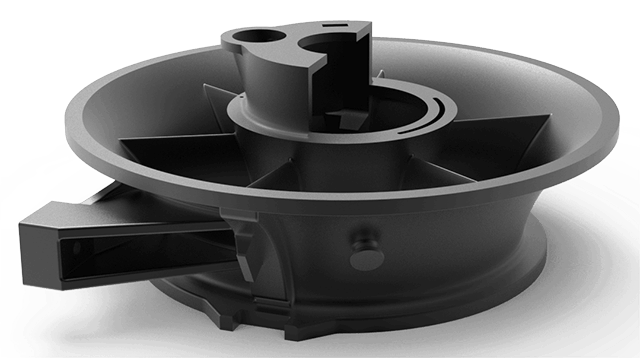
| Part Name | Gas Turbine Pedestal |
| Weight | 8,300 KG |
| Material | Ductile Iron |
The Gas Turbine Pedestal is a critical structural component of the turbine installation assembly, primarily responsible for supporting and transferring the loads imposed by the turbine to the foundation while providing a stable and precisely aligned support structure for the entire turbine assembly.
This structure is subjected to significant static and dynamic loads, vibrations, thermal forces, and operational loads generated during turbine operation. Therefore, the design and manufacturing of the gas turbine pedestal require particular attention to structural strength, dynamic stability, vibration control, and the dimensional accuracy of mounting surfaces.
By providing a precise and stable mounting platform, the Gas Turbine Pedestal plays a crucial role in maintaining proper alignment between the turbine and its connected equipment, including the generator and other associated components. Manufacturing quality and precision machining of the supporting surfaces and mounting interfaces directly influence the reliable operation and service life of the equipment.
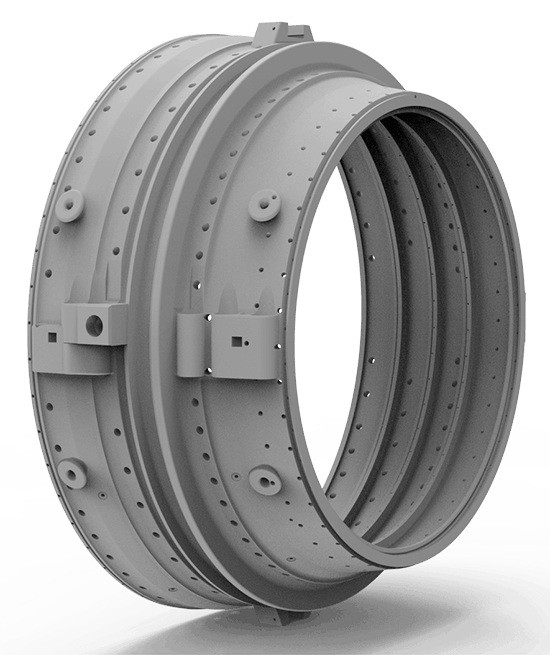
| Part Name | Gas Turbine Blade Carrier |
| Weight | 9,000 KG |
| Material | Steel |
The Turbine Blade Carrier is a critical component of the turbine section in gas turbines, primarily responsible for supporting, securing, and precisely positioning the turbine blades within the hot gas flow path. This component plays a vital role in maintaining the correct geometry and alignment of the blades, thereby ensuring stable operation and optimal turbine efficiency.
The Turbine Blade Carrier operates under demanding conditions, being subjected to high temperatures, pressure differentials, mechanical forces, vibrations, and thermal and cyclic stresses. Therefore, its design and manufacturing require precise control of mechanical properties, thermal stability, and geometric accuracy.
Precise positioning of the blade mounting and support interfaces, proper alignment, tight dimensional tolerances, and high-quality machined surfaces are among the key requirements for the Turbine Blade Carrier. Furthermore, appropriate material selection and carefully controlled manufacturing, heat treatment, and machining processes play a crucial role in enhancing the reliability and extending the service life of this component.