
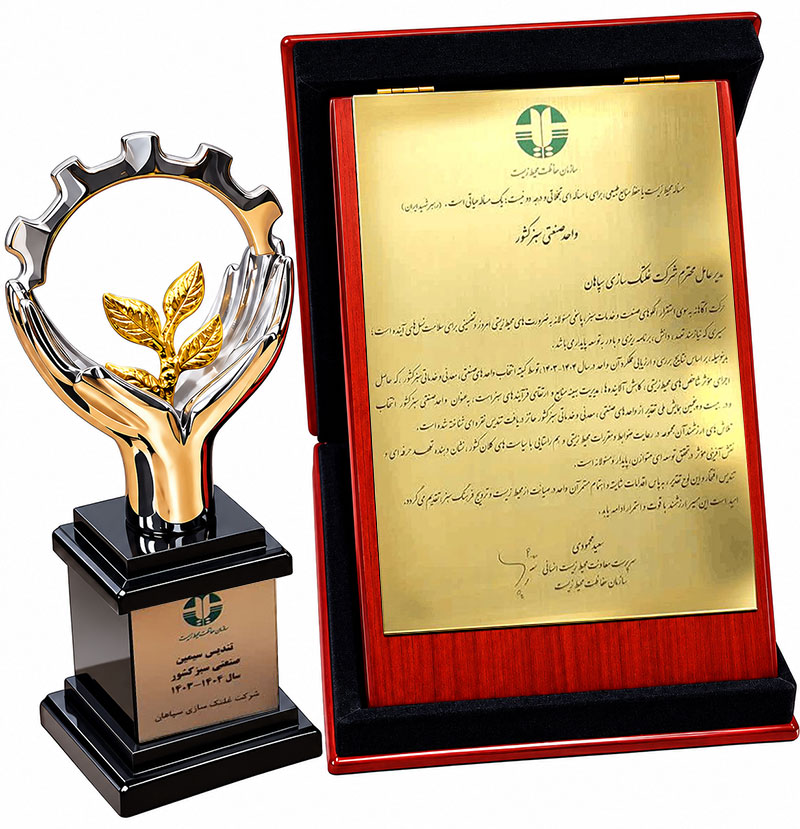
Ghaltak Sazan Sepahan Receives the Simin Award at the 25th National Green Industry Conference
In line with its commitment to corporate social responsibility, sustainable development, and environmental protection, Ghaltak Sazan Sepahan Company participated in the 25th National Green Industry Conference and was honored with the Simin Green Industry Award in recognition of its environmental achievements.
This achievement reflects the company's commitment to environmental requirements and performance indicators, as well as its ongoing efforts to minimize the environmental impacts of industrial operations. The company's approach in this area focuses on pollution prevention and control, proper management of industrial waste, environmental pollutant monitoring, efficient resource and energy management, and continuous improvement of environmental performance.
Receiving the Simin Green Industry Award, beyond its significance as a corporate achievement, further reinforces the company's responsibility to sustain and expand its environmental initiatives. Ghaltak Sazan Sepahan Company considers environmental protection an integral part of its responsibility toward its employees, the surrounding community, and future generations. Accordingly, the company remains committed to responsible manufacturing practices and the pursuit of sustainable development as key priorities in its operations.
The Health, Safety, and Environment (HSE) Department also plays an active role in maintaining and strengthening this commitment through continuous monitoring of environmental performance, identification and control of environmental aspects, and implementation and follow-up of environmental improvement programs.
Environmental Protection
As part of its corporate social responsibility and commitment to environmental protection, Ghaltak Sazan Sepahan Company has purchased an industrial dust and fume collection system from Canada to eliminate airborne pollutants, including dust and fumes generated during the metal melting process.
Thanks to its exceptionally high suction capacity, this system effectively captures and collects dust and fumes emitted from the melting furnaces.
The dust and fume collection system consists of the following components:
- Dust and Fume Collection System: A canopy hood and approximately 100 meters of ductwork for conveying dust and fumes.
- Spark Arrestor: Designed to prevent sparks from entering the filtration system.
- Inlet Collector: Directs the collected dust and fumes into the filter housing.
- Filter Housing: Measuring approximately 3.6 × 10 × 10 meters.
- Bag Filters: Equipped with 616 filter bags, each measuring 16 cm in diameter and 3.7 meters in length, providing a total filtration area of 1,160 m².
- Exhaust Fan: A radial centrifugal fan powered by a 250 kW electric motor operating at 1,400 rpm.
- Dust Discharge System: Includes a screw conveyor and rotary valve for removing collected dust from the filter housing.
- Pulse-Jet Cleaning System: Comprises 44 rows of pulse-jet cleaning units operating at a pressure of 6–8 atmospheres to remove accumulated dust from the filter bags.
- Exhaust Stack: Measuring 2 meters in diameter and 18 meters in height.
The installation of this advanced dust and fume collection system represents a significant step toward reducing industrial air emissions, improving workplace air quality, and supporting the company's commitment to environmental sustainability.
The process begins with the collection of dust and fumes emitted from the melting furnaces, which are conveyed through a ductwork system. After passing through a spark arrestor, the dust-laden air enters the baghouse dust collection unit.
Due to the negative pressure generated inside the filter housing, clean air passes through the fabric walls of the filter bags and is subsequently discharged into the atmosphere through the centrifugal fan and exhaust stack.
Meanwhile, dust particles accumulate on the outer surfaces of the filter bags. At regular intervals, the pulse-jet cleaning system injects bursts of compressed air into the bags, dislodging the accumulated dust and causing it to fall into the lower section of the filter housing.
The collected dust is then discharged from the bottom of the housing through a screw conveyor and rotary valve.
Through this filtration process, pollutant emissions from the exhaust stack are reduced to permissible levels, ensuring compliance with the environmental standards referenced in the company's documentation.
Technical Note: The original text refers to OHSAS standards. However, OHSAS primarily addresses occupational health and safety management rather than specific industrial air emission limits. For technical accuracy, the applicable national environmental emission standards should be referenced when specifying permissible pollutant concentrations.

Industrial Dust Collection System

Wastewater Treatment Plant
Environmental Protection
This wastewater treatment system has a treatment capacity of 50 cubic meters of domestic wastewater per day. Utilizing a packaged steel wastewater treatment unit, it treats the wastewater generated at the factory to meet environmental discharge standards. The treated effluent is subsequently reused for landscape irrigation and to supply part of the make-up water required by the cooling towers of the company's melting furnaces. The treatment process consists of physical, chemical, and biological treatment stages. Raw wastewater is treated using the activated sludge process, with adequate aeration and sufficient hydraulic retention time to ensure effective wastewater treatment.
Environmental Protection
This fully automated sand storage and distribution system, with a total capacity of 600 tons, is designed to receive and store incoming foundry sand in separate silos and subsequently distribute it to various production areas throughout the factory. By facilitating the efficient supply of sand to different sections of the foundry workshops, the system also helps prevent dust emissions associated with sand unloading and handling at individual points of use. In this system, sand is initially discharged into a receiving hopper. A PLC-controlled automation system then transfers the sand through a series of sequential operations to the designated storage silo. Based on operational requirements, the daily-use silos are supplied with sand through discharge chutes located beneath each of the 200-ton storage silos, ensuring a continuous and controlled supply of sand for production processes.
